
What is Dacha
Dacha is a game engine for 2D browser games, with a visual editor. It has two parts, and you use both:
dacha— the engine. An npm package your game imports.dacha-workbench— the editor. A desktop application you point at your project.
Your game is an ordinary web application. You add the engine as a dependency and build the game with a bundler of your choice.
The game world is described by data
Section titled “The game world is described by data”You do not write a startup script that builds the game world. You describe the world in a file. Scenes, actors, components, templates, which systems run, and the settings they run under are all entries in one JSON file. This file is called the configuration.
The engine reads the configuration at startup and creates the running world from it.
You are not expected to write that file by hand. The editor writes it.
The configuration says what exists. It never says what happens. Logic lives in the TypeScript you write.
The editor is a separate application
Section titled “The editor is a separate application”You launch the editor yourself, and it reads your project:
- The configuration, so you can build scenes by dragging actors around.
- Your assets directory, so an image you drop in becomes selectable straight away.
- Your own components and systems, so they appear in the inspector with their fields laid out, next to the built-in ones.
The third one is what makes the editor useful on a real project. You do not have to wire it up.
The editor writes to your project too. Ask it for a new component, system or behavior and the file lands in your source. Both the game and the inspector pick it up.
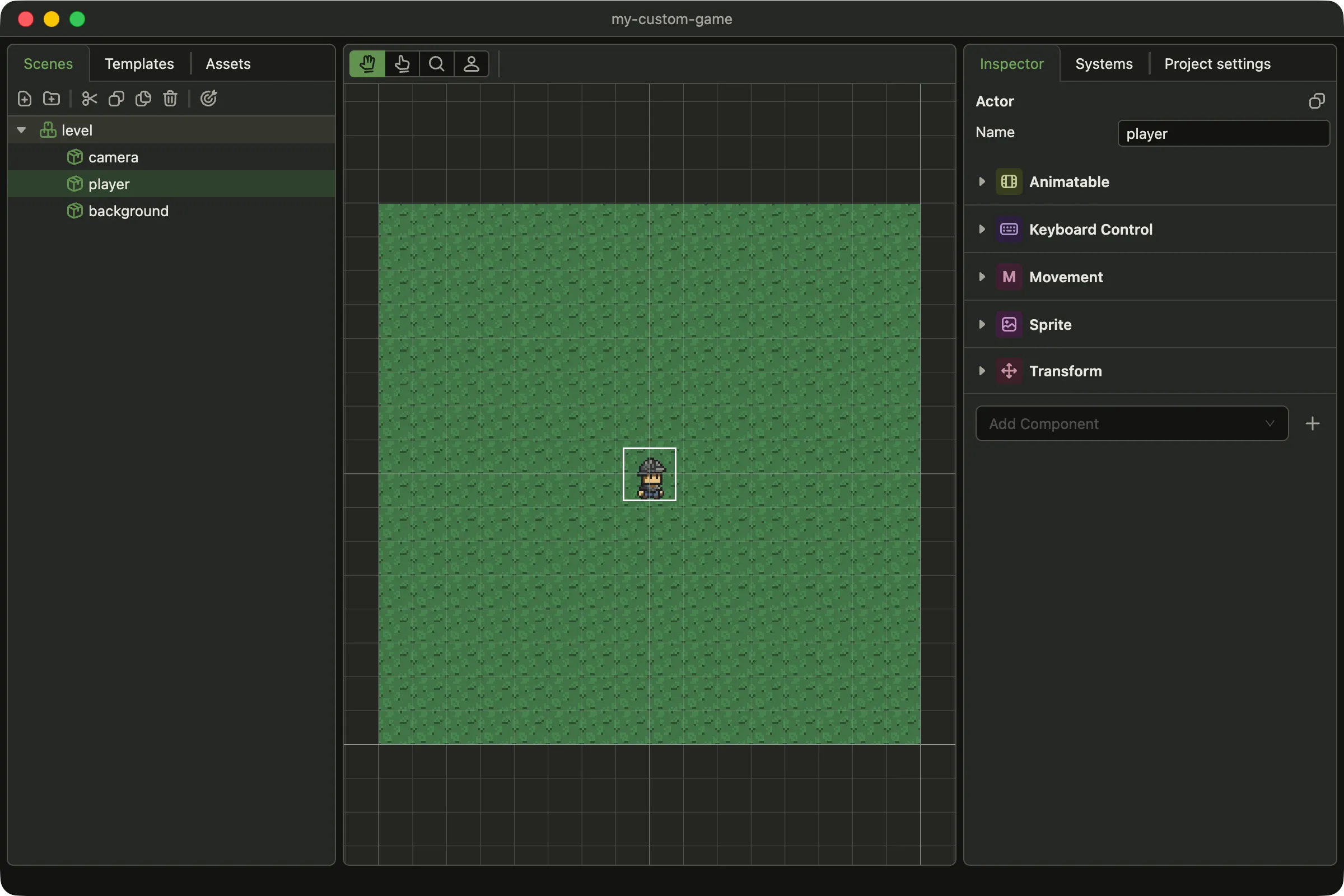
The editor: the scene tree, the viewport, and the inspector for the selected actor.
Movement there is a component from the game’s own source. The inspector lists it
exactly like the engine’s own components.
What comes with it
Section titled “What comes with it”- Built-in systems for rendering, physics, character movement, interpolation, animation, audio, keyboard and mouse input, cameras, behaviors and mounting a user interface.
- Built-in components for those systems to read: transforms, sprites, meshes, text, shapes, colliders, rigid and character bodies, cameras, audio sources and the rest.
The built-in classes get no special treatment from the engine. They are the same kind of class you write yourself. Enable the systems you need, ignore the others, and add your own next to them.
Where it fits
Section titled “Where it fits”Dacha suits 2D browser games where you want a visual scene editor without adopting a large engine, and where the game logic is comfortable in TypeScript. It has been used to build games for game jams. That is the workload it is shaped around: small teams, short timelines, and a browser as the target.
When not to use it
Section titled “When not to use it”- It is 2D only. There is no 3D pipeline and none is planned.
- The target is the browser. There is no console export and no native desktop or mobile packaging. Browser games do run on mobile browsers.
- It is a small project. There is no asset store, no plugin marketplace, and no commercial support.
If any of those is a requirement, a larger engine will serve you better.
If none of that rules it out, installation gets a project running in a few minutes.