
Behaviors
A behavior is logic that belongs to one actor. Where a system works over a whole class of actors at once, a behavior is built for one actor and runs only for it.
You declare one by extending Behavior and naming it with a decorator. The shape is close
to a system, and the differences are the interesting part.
A complete behavior
Section titled “A complete behavior”import { Behavior, DefineBehavior, DefineField } from 'dacha';import type { Actor, BehaviorOptions, Time } from 'dacha';
@DefineBehavior({ name: 'GrowPlant',})export default class GrowPlant extends Behavior { @DefineField({ initialValue: 4 }) secondsPerStage!: number;
@DefineField({ initialValue: 3 }) stages!: number;
private actor: Actor; private time: Time; private elapsed = 0; private stage = 0;
constructor(options: BehaviorOptions) { super(options);
this.actor = options.actor; this.time = options.time; }
update(): void { if (this.stage === this.stages) { return; }
this.elapsed += this.time.deltaTime;
if (this.elapsed < this.secondsPerStage) { return; }
this.elapsed = 0; this.stage += 1; // swap the sprite for the next growth stage }}A behavior differs from a system in three places.
options.actor is the actor this instance belongs to. It is the whole reason to write a
behavior instead of a system, and it is always there. A behavior is never built without one.
The lifecycle is shorter. A behavior has update, fixedUpdate and destroy, and
nothing else. All three are optional, the way a system’s hooks are. What is missing are the
scene hooks. There is no onSceneLoad, so a behavior is not the place to load resources, and
destroy is the one hook a system has no equivalent of.
The fields belong to the attachment, not to the class. A system’s fields are edited once,
in the systems list. A behavior’s fields are edited on the actor that carries it, so two actors
can run the same behavior with different values. The engine fills them from the options
object, the same way it fills
component fields. Pass options to
super, or the fields keep their initial values.
Inspector fields covers the widgets and the options they
take.
How the actor finds the class
Section titled “How the actor finds the class”Nothing imports GrowPlant except the glob that collects it. The actor refers to it by name.
An actor takes part by carrying a Behaviors component, which holds a list of entries. Each
entry is a name and an options object. When the scene starts, the behavior system reads that
list, finds the class whose behaviorName matches, and constructs it.
Two consequences follow from the indirection, and both are useful.
The same class can be attached twice to the same actor with different options, because each
entry produces its own instance. And a name with no matching class is not a crash. The
behavior system writes Behavior not found: GrowPlant to the console, skips that entry, and
runs the rest. See when the class never
arrives.
What a behavior receives
Section titled “What a behavior receives”The constructor gets one object. Your own fields sit next to what the engine supplies:
| Field | What it is |
|---|---|
actor |
The actor this behavior belongs to |
scene |
The scene that actor is in |
world |
The world, including systemApi |
actorSpawner |
Creates actors from templates at runtime |
assets |
The registry of the project’s assets |
globalOptions |
The global settings for the game |
time |
Shared timing state |
When your code runs
Section titled “When your code runs”The behavior system builds every behavior on every participating actor when the scene becomes active, and it builds them for an actor added later as soon as that actor appears. So your constructor runs once per attachment, not once per scene.
update and fixedUpdate then run on the two clocks, exactly as they do for a system. The
behaviors of one actor run in the order the list holds them.
destroy runs when the actor is removed or the scene is torn down. It is where a behavior
gives back whatever it took:
destroy(): void { this.scene.removeEventListener(Harvest, this.handleHarvest);}Whatever you subscribe to in the constructor, you unsubscribe from in destroy. Nothing does
it for you.
This matters more for a behavior than for a scene system. A system is destroyed together with its scene, so a listener it put on that scene dies with it either way. A behavior is destroyed whenever its actor is removed, which happens constantly while the scene keeps running. Every projectile that hits something and disappears leaves its listener behind.
Attaching one
Section titled “Attaching one”In the editor, select an actor, add the Behaviors component, and pick the behavior from
the list. Its decorated fields appear underneath, and the values you type there are saved
into that actor’s entry. A template works the same way, and every actor built from it starts
with the behaviors the template carries.
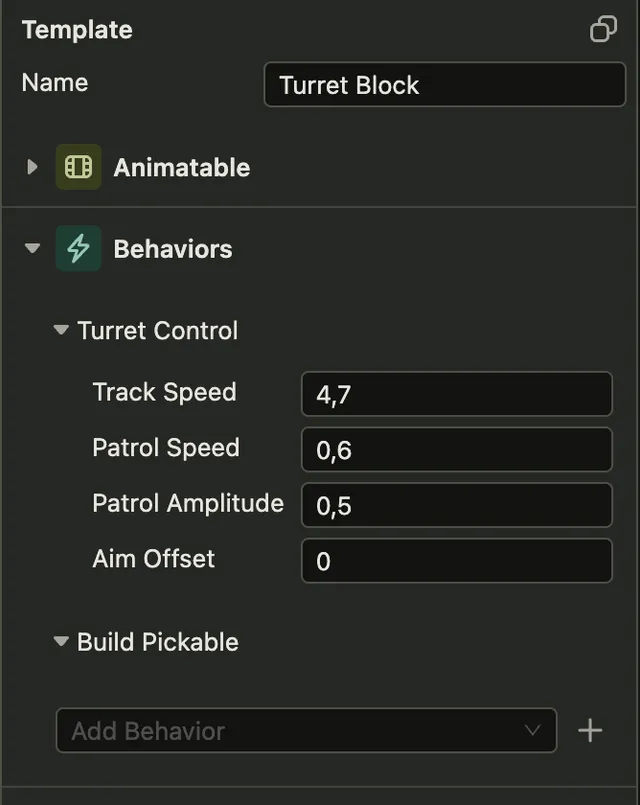
By hand, the same thing is one entry in the configuration:
{ "name": "Behaviors", "config": { "list": [ { "id": "5e5c2d5a", "name": "GrowPlant", "options": { "secondsPerStage": 4, "stages": 3 } } ] }}Registering them
Section titled “Registering them”A behavior is neither a system nor a component, so it does not go in either array. It reaches
the engine as a resource belonging to the behavior system. The *.behavior.ts suffix collects
the class and the starter project passes it on, so there is
nothing to do by hand. See how scripts are found for the code
that does it.
When a system is the better choice
Section titled “When a system is the better choice”A behavior instance exists per actor, and so does its work. Ten thousand actors with the same
behavior means ten thousand update calls, where a system would do one pass over one query.
The question to ask is not about performance, though. It is about what the logic is about. Logic that is specific to one actor is awkward to write as a system. Systems are a better fit for logic that applies to a class of actors, such as damage, movement, or collision response.